
South Carolina Car Accident Laws
- Free consultation
- No fee unless we win
- Available 24/7
South Carolina car accident laws set the rules of the road and require drivers to stop and report injury crashes. Every registered car must carry liability and uninsured motorist coverage. Seat belt violations stay out of injury cases, and drivers may not hold a phone while driving. The usual deadline to sue is three years.
Most driving rules come from Title 56, Chapter 5, the Uniform Act Regulating Traffic on Highways. Insurance rules live in Title 38, Chapter 77. Filing deadlines live in Title 15. Each statute sets a duty or a limit, and how one fits your crash depends on evidence a lawyer reviews first.
Frost Law Group takes on car crash injury claims from a Summerville office. Jack C. Frost handles those claims alongside his wife, Tara L. Frost. The Charleston School of Law is where both earned their law degrees. While in law school, Tara was vice president of her school's Student Trial Lawyers Association. They can start with the statutes that fit a crash and the records behind it.
Questions about a single statute are welcome at (843) 419-6653, the Frost Law Group line. Your consultation is free and confidential, and you are under no obligation.
On this page
- Which Rules of the Road Decide Most Crash Claims
- What Must a Driver Do After a Crash
- What Insurance Must Every South Carolina Driver Carry
- How Do the Seat Belt and Hands-Free Laws Affect a Claim
- What Deadlines and Fault Rules Apply to a Claim
- Ask a Summerville Car Accident Lawyer How These Laws Apply to You
Which Rules of the Road Decide Most Crash Claims
No single rule decides most crash claims, but right-of-way, speed and following distance rules come up in many of them. Frost Law Group handles car crash claims that turn on those duties.
The 2024 SCDPS Traffic Collision Fact Book counts the factors officers listed on crash reports, not what decided any claim. On Dorchester County reports that year, officers most often listed failure to yield (986) and driving too fast for conditions (823). Improper lane use (415) and following too closely (408) came next.
Under South Carolina car accident laws, a broken traffic rule does not settle fault on its own. The state Supreme Court's 2012 Fairchild opinion repeats a long-standing rule. Violating an applicable statute is generally negligence per se, meaning the violation itself counts as carelessness. Whether it caused the crash is usually a jury question, so the answer depends on the proof.
Speed, Following Distance and Right-of-Way Statutes
Speed has two limits in South Carolina. One is the posted number. Section 56-5-1520 adds a second, a speed that stays reasonable and prudent for the conditions at hand. Tailgating falls under Section 56-5-1930, which uses that same test and names no set distance. A left turn brings Section 56-5-2320 into play, and the turning driver must give way to oncoming cars close enough to pose an immediate hazard.
Yield signs carry an extra rule in Section 56-5-2330. Suppose a merging driver never stops for the triangle sign and strikes a car already inside the junction. The statute treats that impact as prima facie evidence the merging driver did not yield. Prima facie means enough to prove the point unless other evidence answers it. The rule covers yield signs only, so a crash at a stop sign turns on ordinary proof.
Does the Other Driver's Traffic Ticket Prove Fault?
No. Under Section 56-5-6160, no court may admit evidence of a conviction under the traffic chapter in a civil action. Summerville Municipal Court hears the town's traffic cases at 200 S Main Street. Evidence of a conviction there stays out of your injury case. The facts behind the ticket are a separate matter, and witnesses, photos and video can still show what the driver did.
What Must a Driver Do After a Crash
A driver must stop, share identifying details and help anyone hurt. When a crash injures or kills someone, the driver must also notify police at once. Section 56-5-1230 spells out the details as a name, an address and the vehicle's registration number. The driver shows a license on request and gives reasonable help, such as arranging a ride to a hospital when someone plainly needs care or asks for it.
Penalties for leaving climb with the harm. Driving off after a crash that hurts someone is a misdemeanor, and Section 56-5-1210 allows up to a year behind bars, a fine as high as $5,000, or both. If the person left behind suffers great bodily injury or dies, the charge is a felony instead.
Jack C. Frost put in fourteen years as an officer, corporal, deputy and detective. He served with the Summerville Police Department and then the Charleston County Sheriff's Office. That history lets him see which questions a collision report left open for Frost Law Group to chase down.
When the Law Requires a Call to Police
Section 56-5-1260 demands notice by the quickest means, but only if the crash injures or kills a person. Inside Summerville, that call goes to the town police on North Cedar Street. Beyond town limits, the driver may phone either the county sheriff or the Highway Patrol office nearest the wreck.
A fender bender with no injuries follows Section 56-5-1220 instead. Hitting an unattended car brings in Section 56-5-1240. That driver must track down the owner or leave a written note in plain view naming the driver and owner, with addresses and an account of what happened.
Paperwork Owed to SCDMV After a Crash
Two SCDMV forms follow many crashes, and which one applies depends on whether an officer worked the scene. Section 56-9-350 governs the FR-10, an insurance verification form. After a qualifying crash, the investigating officer gives one to every driver or owner involved. Section 56-5-1270 governs the FR-309, owed when no officer investigated a crash with injury, death or $1,000 in apparent damage. Neither form decides who caused the crash.
What Insurance Must Every South Carolina Driver Carry
Every driver needs liability coverage of at least 25/50/25 plus uninsured motorist coverage at the same limits. Section 38-77-140 sets those figures. The first two numbers are the bodily injury floor, $25,000 a person and $50,000 a crash. The last is the property damage floor, also $25,000. Section 38-77-150 then adds uninsured motorist coverage to each policy as a required piece, with at least $25,000 for your own property, less an optional $200 exclusion.
The Department of Insurance calls South Carolina's approach a tort system, under which the driver at fault answers for the harm. Section 38-77-144 mandates no personal injury protection, and med pay is something you may add or skip. Section 56-10-10 makes the owner of each vehicle that must be registered keep the required coverage in place. Frost Law Group handles at-fault claims against the other driver's liability insurer and claims under your own policy when that insurer falls short.
Underinsured motorist coverage works differently. Your insurer has to offer it up to your liability limits under Section 38-77-160. Nothing forces you to buy it. Picture a driver with a 25/50/25 policy who runs a red light on Central Avenue and breaks your leg. Once that $25,000 per-person limit runs out, underinsured coverage on your own policy may pay more, subject to its terms and the proof.
How Do the Seat Belt and Hands-Free Laws Affect a Claim
Nobody may use a missing seat belt against you in a South Carolina injury case. The other driver's phone use is different, and it may count against that driver. Both rules sit in the same traffic chapter, yet they cut in opposite directions. An adjuster may still bring up an unbuckled belt, so the exact statutory words matter.
Frost Law Group can read both statutes against the crash report and the medical records. An officer may note belt use on the report. Witnesses or video may show a driver looking down at a screen. The belt question usually ends with the statute, while the phone question turns on proof.
Section 56-5-6540 and the Unbuckled Driver
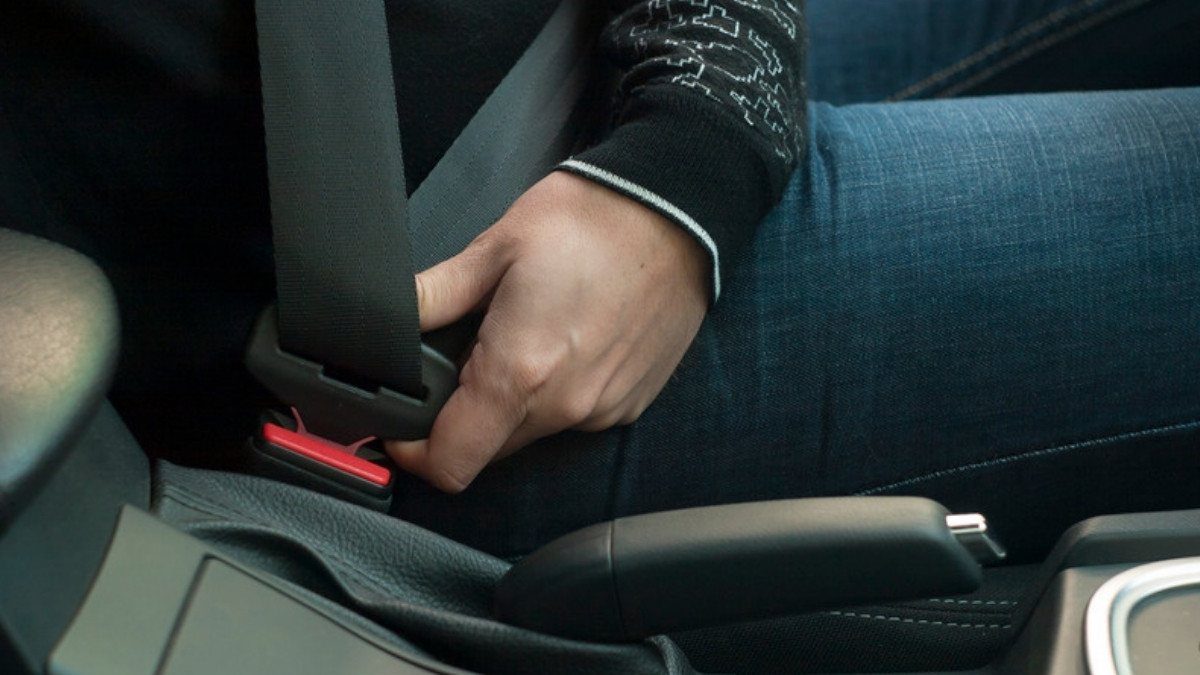
Section 56-5-6520 requires a fastened belt for the driver and each passenger on public streets and highways. The fine tops out at $25, and the violation is not a crime. It stays off your SCDMV driving record and out of any report to your insurer. For injury cases, Section 56-5-6540(C) declares the violation neither negligence per se nor contributory negligence, and it keeps the violation out of evidence in civil actions.
Phones in Hand Under 2025 Act No. 40
The enrolled text of 2025 Act No. 40 rewrote Section 56-5-3890, effective September 1, 2025. On a public highway, a driver may not hold a phone or prop it against the body. Typing or reading texts, emails or app content is also barred, and so is watching video. Voice calls through an earpiece or a watch stay legal.
The fine is $100 for a first violation. Within three years, a second one brings a $200 fine and two points. Officers could give only warnings for the first 180 days after the law took effect, and that window has closed. Frost Law Group handles distracted driving crash claims. Think of a driver tapping a map app while heading up North Main Street toward I-26 Exit 199. The weight of a violation depends on the facts, including whether the phone use caused the crash.
What Deadlines and Fault Rules Apply to a Claim
Most injury suits must start within three years, and a person held more than 50% at fault recovers nothing. The three-year limit in Section 15-3-530 covers injury claims, vehicle damage claims and wrongful death claims. A wrongful death claim runs from the date the person died. Before any date passes, Frost Law Group can check South Carolina's car accident filing deadlines against your timeline.
South Carolina uses modified comparative negligence. A jury trims your award by your own share of the blame, and a share over 50% bars any award. A defendant under 50% at fault has owed only its own share since 2005, under Section 15-38-15. Act No. 42 of 2025 lets the jury also weigh the fault of people never named in the suit, for claims arising after January 1, 2026. How fault divides in a given crash depends on the evidence, so nobody can honestly predict a percentage.
Exceptions That Change the Three-Year Count
For injury claims, Section 15-3-535 starts the clock on the day you learned of the claim, or the day a reasonably diligent person would have learned of it. That discovery rule does not reach the separate three-year limit for vehicle damage. Time before an injured child turns 18 does not count. Section 15-3-40 caps that extra time at one year after the 18th birthday, and the ordinary three years control when they end later. Filing also starts a suit only when actual service follows inside 120 days, as Section 15-3-20(B) provides.
What if a Government Vehicle Hit You?
When a town, county or state vehicle caused the crash, your claim runs through the Tort Claims Act. Section 15-78-110 allows two years to sue after you discover the loss, or after you reasonably should have. You get three years only by first filing a verified claim with the public body involved. Under Section 15-78-80(d), that body must have the claim in hand inside twelve months of that same discovery date.
Ask a Summerville Car Accident Lawyer How These Laws Apply to You
A statute states the rule, and your crash supplies the facts that decide how the rule plays out. Frost Law Group can compare the collision report, your insurance papers and your medical records with the South Carolina car accident laws that fit them. That review shows which duties the other driver may have broken and which deadline controls your claim.
The office sits at 128 Linwood Lane, Summerville, SC 29483. Tara and Jack Frost meet there with people hurt in crashes. When you phone, an attorney takes your questions, and no call center stands in between. Ask for a free, confidential consultation, and bring the FR-10 copy or the report number if you have either one.
Frost First means calling with even a single question about a single statute. Dial (843) 419-6653, or leave the office a note online with the crash date and your question.

The attorneys at Frost Law Group
 Tara L. FrostAttorney at Law · Personal injuryTara L. Frost focuses on personal injury, car accident and truck accident claims. A lifelong resident of the tri-county area, she meets clients at the Linwood Lane office in Summerville.
 Jack C. FrostAttorney at Law · Former Summerville police officer and Charleston County Sheriff's Office detectiveJack C. Frost spent fourteen years in law enforcement with the Summerville Police Department and the Charleston County Sheriff's Office before he practiced law.